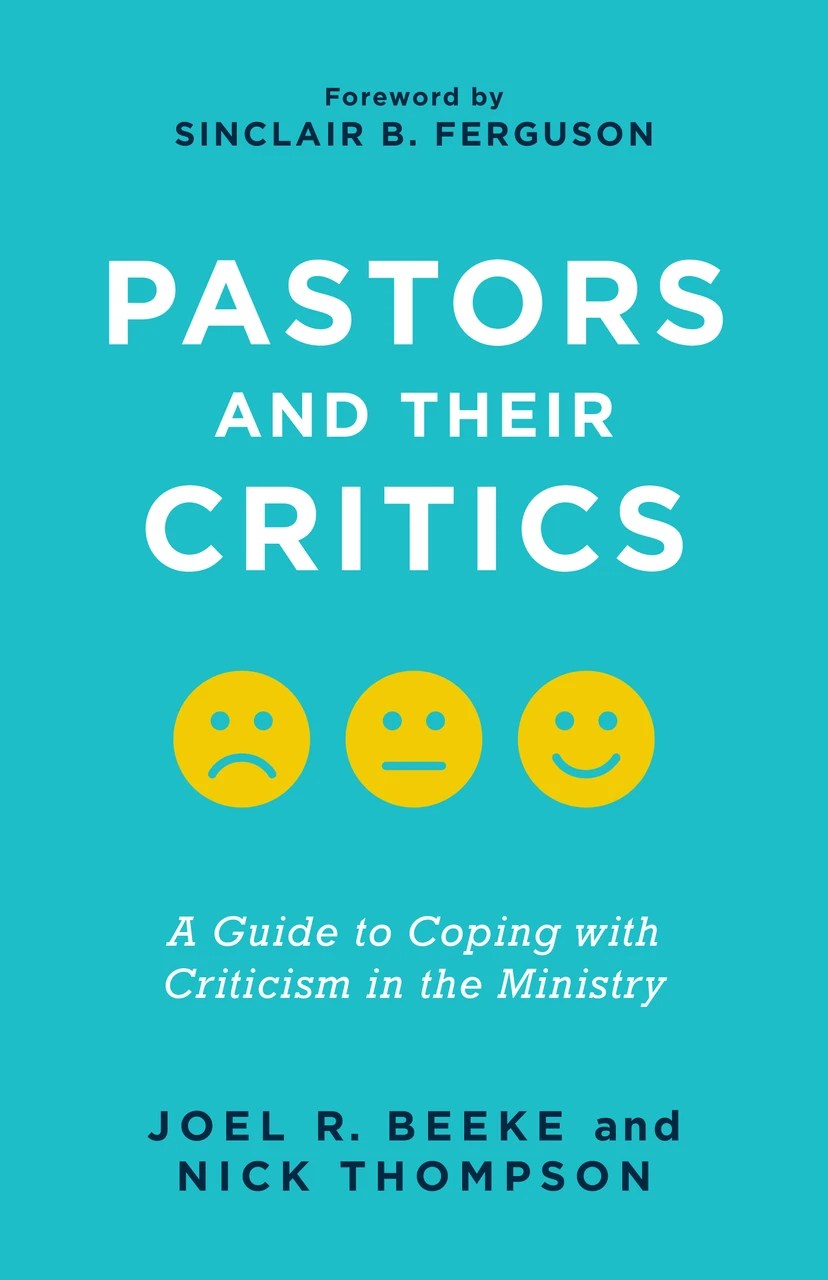
Joel R. Beeke and Nick Thompson, Pastors and Their Critics: A Guide to Coping with Criticism in the Ministry (P&R Publishing, 2020, 192 pages).
If you’ve served in a church for any length of time, you know the feeling: it’s Sunday evening, the sermon is behind you, and suddenly a letter, a comment, a conversation in the hallway knocks the ground out from under you for the rest of the week. What won me over in this book is that the authors don’t write about criticism from a distance, in the abstract. Joel Beeke is pastor of Heritage Reformed Congregation and president of Puritan Reformed Theological Seminary, and Nick Thompson is a graduate of the same seminary. Both write not as theorists, but as men familiar with ministry from the inside.
The authors show that the Bible is full of examples of criticism, and from it they draw out practical principles: how to respond to criticism, how to give criticism yourself in love, and how to build a healthy culture in the church. Through this they show a theological vision for enduring criticism in pastoral ministry.
Principles on criticism from the book
The authors offer several important principles:
• If you preach the truth, sinful human nature will react to it. Criticism isn’t a sign that you’re doing something wrong; often it’s a sign that the word has struck something alive.
• Sin will provoke criticism, and Satan will provoke criticism — but God employs both for His own purposes. Even unjust criticism doesn’t fall outside God’s sovereign hand; He is able to turn it to good.
• It’s normal for some people to love you and others to hate you. A pastor isn’t called to please everyone; faithful ministry of the truth inevitably divides people’s reactions.
How to receive and handle criticism
Before responding to criticism, the book suggests asking yourself several questions.
What is the critic’s spiritual state? Jesus said the world will hate us (John 15:18–19), and that’s normal. But a critic may also be a spiritual infant — a believer who hasn’t yet learned to clothe a remark in love. And if the critic is a spiritually mature person, his words deserve especially careful attention.
Am I dealing with an active or inactive church member? If the criticism comes from someone in your congregation, it matters how involved they actually are in the life of the church. Often it’s the inactive members who criticize the most — without sharing in the responsibility for what happens inside it.
What is our relationship with this person? The closer someone is to us, the more we should listen — they don’t see us from a distance. It’s different if someone posts a harsh word online, a person we don’t know at all: that voice doesn’t need to be given the same power over our hearts.
How many people are saying the same thing? A single voice can often simply be let go. But if several different people repeat the same criticism — the more voices, the more carefully we should listen: perhaps God is speaking through them.
What are the motives behind the criticism? It’s worth asking what’s going on in the critic’s life. Depression, illness, trouble at work or at home often spill out as harsh words toward someone else. Criticism frequently reveals more about the state of the critic than about the one being criticized — sometimes a person criticizes the minister who has confronted their sin simply to quiet their own conscience. Here it’s important to discern: does this person want good for the ministry — or its ruin? If the criticism is rooted in anger and falsehood rather than love and truth, it is illegitimate, and should be treated accordingly.
I closed this book feeling understood by someone who knows what he’s talking about. That’s what makes it valuable for anyone carrying pastoral ministry — and, honestly, for every Christian who has ever heard an unjust word directed at them.
«Blessed are you when they revile and persecute you, and say all kinds of evil against you falsely» (Matthew 5:11).

